Get on Camera: A Practical Starting Guide for Real Estate Agents

It’s no secret that real estate runs on relationships, and relationships run on trust. Before a client signs a contract, they have to believe that you know the market, that you have their interests in mind, and that you are someone worth spending the next few months of their life working alongside. That kind of trust used to be built entirely in person. Now it starts online, often before a potential client has ever reached out to you, and video is one of the most powerful ways to build it.
If you have been telling yourself that video is something you will get to eventually, or that it is better suited for agents who are more polished, more outgoing, or more comfortable on camera, this post is for you. Because the agents who are winning on video right now are not the ones with the best lighting or the most confident delivery. They are the ones who decided to stop waiting until they felt ready and started showing up anyway.
Here is everything you need to know to get started, including how to quiet the voice in your head that says you are not cut out for this.
The Case For Video
There is a reason every platform, from Instagram to YouTube to LinkedIn, has prioritized video in its algorithm over the last several years. Video builds trust faster than any other format. A potential client can read your bio and scroll your feed and still feel like they do not know you. Two minutes of watching you talk about the local market tells them more about who you are than a year's worth of polished static posts.
For real estate agents specifically, the case for video is even stronger. You are asking people to make one of the largest financial decisions of their lives with you as their guide. That requires a level of trust that text simply cannot build on its own. When someone watches you explain the difference between a seller's market and a buyer's market, or walk through a listing and point out details they would have missed, they start to feel like they already know you. And when they are ready to move, they call the person they feel like they know.
Video also works while you are not. A well-made market update video or neighborhood tour continues to bring in views and generate inquiries long after you hit publish. Unlike a conversation you have to show up for every time, video is a scalable version of your expertise.
Tip 1: Set Up a Simple, Repeatable Recording Space
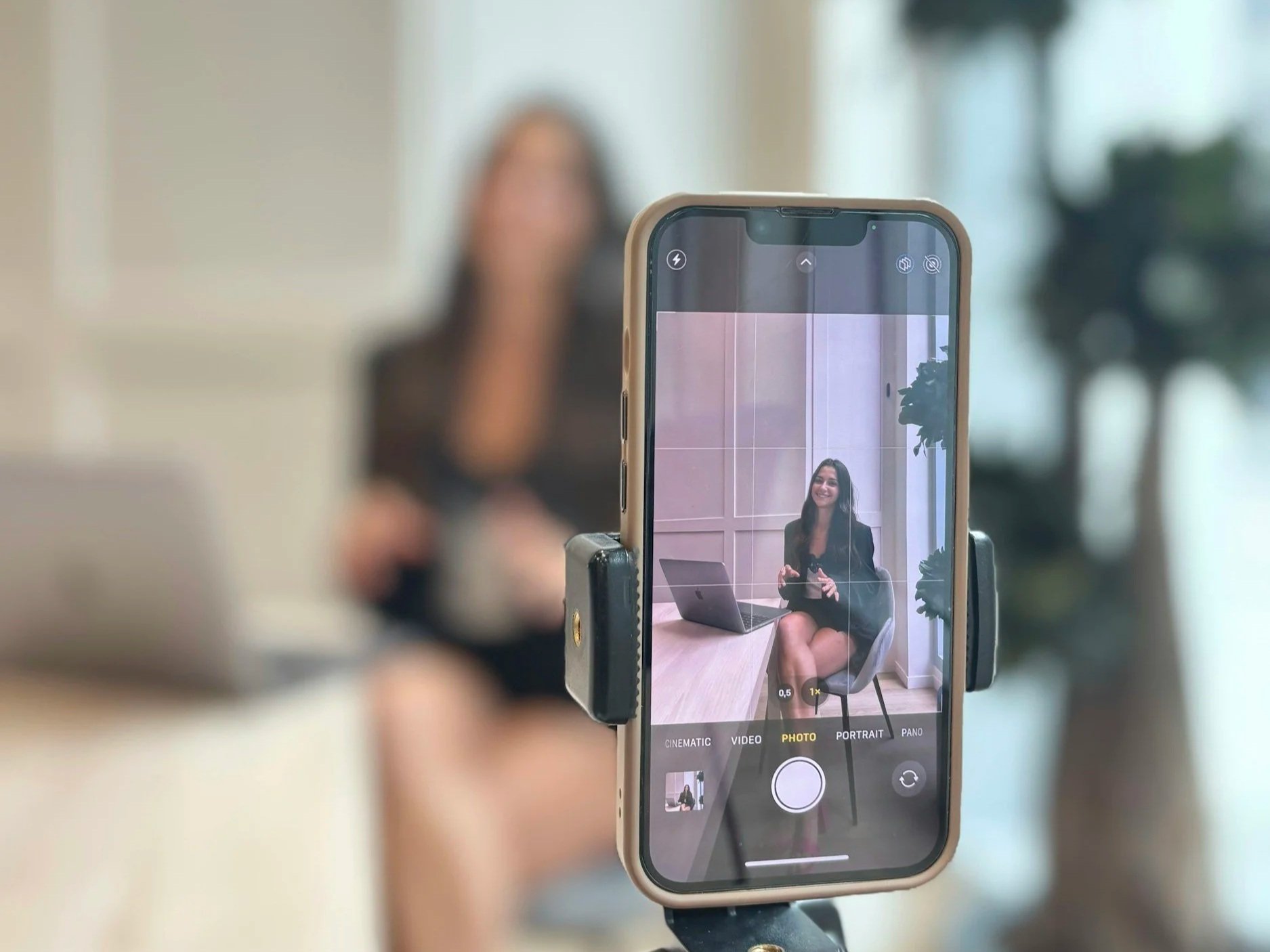
You do not need a studio. You need a space that looks clean on camera, has good natural light, and is quiet enough that your audio is clear. That is the entire list.
Natural light from a window in front of you (not behind you) is your best friend. Filming with the light behind you creates a silhouette effect that makes you look like a witness protection subject. Position yourself so the light falls on your face evenly. If you are filming later in the day or in a darker space, a ring light or a simple desk lamp placed in front of you will do the job.
Your background matters more than you might think, not because it needs to be impressive, but because it needs to be intentional. A tidy bookshelf, a clean wall, or a view of your office signals professionalism. A pile of papers, a cluttered kitchen counter, or a blank wall that looks like you filmed in a storage room sends a different message. Walk your home or office and find two or three spots that look presentable on camera. Mark them as your filming locations and do not overthink it.
Audio quality is more important than video quality. People will tolerate a slightly grainy image, but they will click away from a video where they cannot hear you clearly. If you are filming on your phone, the built-in microphone is usually sufficient if you are in a quiet room. If you are somewhere with echo or background noise, a basic clip-on lapel microphone costs less than a dinner out and makes a significant difference.
The goal here is to remove friction. When your filming space is already set up and ready to go, you are far more likely to actually record. Every time you have to rearrange furniture or find somewhere quiet, you give yourself another reason to put it off.
Tip 2: Script Less Than You Think You Need To
Most agents who are new to video fall into one of two traps: they either try to memorize a word-for-word script, which makes them sound robotic and stiff, or they wing it completely, rambling for four minutes without a clear point. Neither serves your audience.
The approach that works for most people is an outline, not a script. Before you film, write down three things: what you want to say in the first 15 seconds to get someone's attention, the two or three main points you want to make, and how you want to close. That is it. Everything else can be conversational and in your own words.
Practice saying your key points out loud before you film. Not to memorize them, but to hear how they sound coming out of your mouth. Sometimes something reads perfectly on paper but sounds awkward when you say it. The more you talk through your content before filming, the more natural you will sound when the camera is on.
Give yourself permission to film multiple takes. This is not live television. You can stop and start as many times as you need to. Most agents who feel like they are not natural on camera are comparing their raw footage to finished, edited content they see from other creators, and they are not accounting for the fact that what looks effortless usually took several attempts to get right.
Tip 3: Understand That Camera Awkwardness Is Normal and Temporary
Here is what nobody tells you about being uncomfortable on camera: it is not a sign that you are wrong for video. It is a sign that you are new to it. The two things feel identical from the inside, but they are not.
Think about the first time you led a listing presentation, or the first time you negotiated a difficult contract, or the first time you had to deliver bad news to a client. You were uncomfortable. You probably rehearsed more than you needed to and still felt like you stumbled through it. And then you did it again, and again, and somewhere along the way it became something you could do without thinking. Video works exactly the same way.
The discomfort you feel on camera is a product of self-consciousness, and self-consciousness fades with repetition. When you are new to video, you are hyperaware of your hands, your voice, your facial expressions, and every place where you stumble. But your audience is not watching with that level of scrutiny. They are listening to what you are saying. They are deciding whether you seem knowledgeable and trustworthy. They are not cataloging your filler words or counting how many times you blinked.
The fastest way through camera awkwardness is simply to film more. Not perfect videos. Just more videos. Many agents find it helpful to film something every day for two weeks without posting any of it, just to get comfortable with the experience of being on camera. By the end of those two weeks, the camera has stopped feeling like a threat and started feeling like a tool.
Tip 4: Start Hyper-Local and You Will Never Run Out of Content
One of the most reliable video strategies for real estate agents is also one of the most underutilized: become the definitive on-camera source for your specific market.
Agents often think they need to post broad, universally applicable content to attract a wide audience. In reality, the opposite is true. The more specific and local your content, the more valuable it is to the exact people you want to reach. Someone who is considering relocating to your city is not looking for a general overview of the national housing market. They are looking for someone who knows the difference between two neighborhoods that are only three miles apart and can explain why that difference matters.
This creates an almost unlimited content library. Every neighborhood you serve has a personality worth documenting. Every local business district has developments worth commenting on. Every shift in your local market has implications worth explaining. Every listing you take is an opportunity to show your area through the lens of someone who actually lives and works there.
Hyper-local video content also performs well in search over time, particularly on YouTube and through Google's growing tendency to surface video results. A video titled something like "What It's Actually Like to Live in [Neighborhood Name]" has a far longer content life than a trend-driven video that is relevant for a week and forgotten the next.
If you are not sure where to start, begin with the neighborhood you know best. Talk about what makes it different, what the market has been doing lately, what buyers consistently underestimate about it, and what sellers need to know if they are thinking about listing. That is four videos right there, and you have not left your area of expertise.
Tip 5: Post Consistently Rather Than Perfectly
Consistency beats quality when you are just starting out. An agent who posts one imperfect video every week will build more momentum, more trust, and more visibility than an agent who spends three months producing a “perfect” video and then posts nothing for six weeks waiting for it to perform.
This is not an argument against caring about quality. It is an argument against letting the pursuit of quality become the reason you never post anything. Your tenth video will be better than your first, regardless of how long you wait to film it, because the only thing that actually improves your video content is making more video content.
Decide how often you can realistically post, not how often you think you should post, and build your schedule around that number. One video per week is sustainable for most agents and is enough to build genuine traction over time. If one per week feels too aggressive right now, start with two per month. The frequency matters less than the regularity.
Your audience learns what to expect from you based on how often you show up. And when you disappear for long stretches, they simply stop expecting you. Consistency is what turns a viewer into a follower and a follower into a client.
The Bottom Line
Video is not the future of real estate marketing. It is the present. The agents who are growing their businesses through content right now are not doing it because they had some natural gift for being on camera. They are doing it because they decided that discomfort was not a good enough reason to stay invisible.
You do not need a production setup, a media personality, or a perfect script. You need a phone, a clear point to make, and the willingness to press record before you feel ready.
Pick a format. Set up a space. Film something this week. It will not be your best video. It does not need to be. It just needs to exist.
The agents who are still waiting until they feel ready will still be waiting a year from now. Start imperfectly, and let the repetition do the rest.
The Engaging Agent helps real estate agents build marketing that actually works. If your online presence has not kept pace with your business, that is exactly the kind of problem we solve.